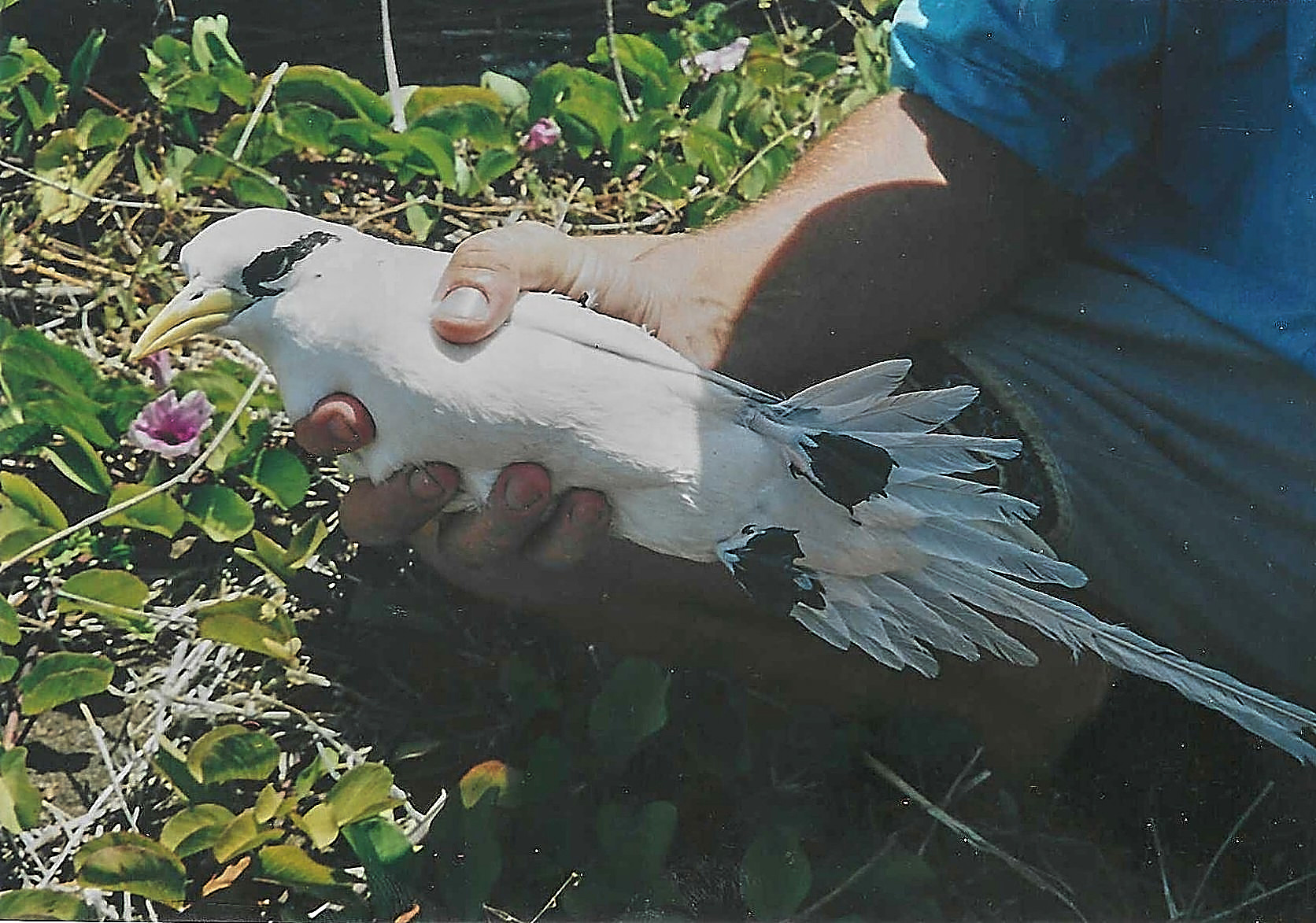
(White Tailed Tropic Bird on Round Island, Mauritius in 2001)
In my last post I wrote about the huge database of wildlife records kept by the wardens on Skokholm. The records seem too random to form a scientific survey, so why do we take part?
I put this in an email to Richard (Brown – one of the wardens) and had this reply:
“I would say that the daily log is much more valuable than you suggest. A log has been kept for nearly 100 years, an amazing record of changes in numbers and the timing of migration. The staff provide the majority of the numbers, which come from census routes walked every day. Of course there is always lots of noise in the data, due to weather and effort, but that becomes much less important when it is looked at over decades. So we can see, for example, that Turtle Dove and Whitethroat numbers have plummeted, Blackcap and Goldfinch numbers have increased. Willow Warblers arrive earlier than they did 50 years ago, with the median spring bird arriving over a week earlier. More interestingly Willow Warblers leave much later, the median autumn bird departing over two weeks later. There is a whole wealth of interesting patterns hidden in over 25 million individual bird sightings, the majority of changes linked to climate and habitat change.”
Keeping records
To make a case for any intervention it is necessary to keep records in a systematic way. I learnt about this from Peter Ulrich, a professional ornithologist in Cumbria who records the bird populations on sites chosen for wind farms. The BTO method is rigorous: a line is drawn on a map and sightings taken along it at specific times and regular intervals over several years. If these records show that a wind farm would have a serious impact on important species then planning can be refused. Clearly the records on Skokholm are underpinned by the systematic records kept by the staff, and are at least as valuable as any other scientific records. There are still questions to be asked though about the way we try to manage what we call “Nature” by which we mean all life on earth except human life.
Biodiversity
All the “Nature Professionals” I’ve met seem to be keen on the restoration of “biodiversity” which doesn’t mean as many species in one area as possible, but something like “as wide a variety of species as would naturally occur in one area.”
Species Protection
The RSPB was founded in protest at the mass killing of birds, such as the Little Egret, for their ornamental feathers. The mission was to stop bird species from being wiped out. Their reserves now put their volunteers to work to boost the numbers of any species which is threatened with extinction or serious decline. This frequently involves nurturing a particular mix of plants which forms a “habitat” for that species. I learned about this from Carl Jones, the man behind the Mauritius Wildlife Foundation, and saw what huge resources they had put into saving, among others, the Mauritius Kestrel and the Pink Pigeon from extinction. However, that does not necessarily lead to a natural balance.
Invasive species
The promotion of biodiversity often involves the removal of “invasive” species – plants animals and insects which have been introduced to an area by human intervention, either deliberately as with for example the Grey Squirrel, or by accident like Japanese Knotweed and rats. The extraordinary wildlife of Round Island off Mauritius was saved by removing introduced goats and rabbits. Some would argue however that if left alone, invasive species and “endemic” species will reach a natural balance.
Rewilding
In general terms “rewilding” means creating, or re-creating the conditions in which the natural world can promote biodiversity without human intervention. However, when the ideas behind the rewilding movement came to prominence in Britain in the 2010s, led by Isabella Tree and George Monbiot, it led to a split between the purists who wanted to re-introduce lost apex predators like the wolf and the lynx, and those who argued for a return to more traditional ways of farming which had nurtured much more biodiversity than modern industrial farming. My experience involved recording rutting deer at Knepp Estate (the home of Isabella tree) and planting trees with Trees for Life in Glen Affric, just to the north of “Cairngorms Connect” – the biggest rewilding project in Britain.
Are Humans the worst invasive species?
It could be argued that all humans are the biggest threat to the natural world. Instead of keeping all these records, manipulating bits of environment etc. we should simply leave it alone. The best thing we could do for the future of the planet is greatly to reduce our numbers.
Thganks for these informative and beautifully photographed posts Dick.
In terms of your last sentence, it seems that through AI we may well be achieving that goal!
I have challenged a couple of friends lately who have been talking about ‘the end of the world’ …it may well be toward the end of humans dominating our world but I think very unlikely that the planet’s existence will end. We are after all a very small blip on the earths history!